
 Hudson Thomas
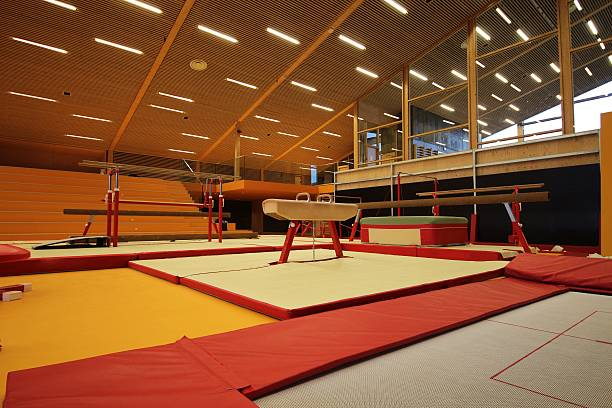
A mixed-age class can quickly become difficult to manage when every participant waits for the same beam or landing space. Stations offer another approach. Each area develops a clear movement skill, while coaches control how children move between tasks. The challenge is not simply to create more activities. It is to offer appropriate progression without dividing the room into isolated groups that cannot be supervised effectively.
Younger beginners may practise balancing along a marked floor line, stepping over low obstacles and landing in a controlled position. More confident participants can work on carefully selected beam sequences or supported shapes suited to their ability. Age is a useful starting point, but previous experience, coordination, confidence and readiness should determine the final task. A teenager trying gymnastics for the first time may need a simpler station than a younger child with years of training.
A balance station might progress from floor markings to a low beam, with clear instructions on mounting and finishing. A strength and control station could use supervised holds, safe body positions and short movement sequences. A movement station can focus on rolls or other skills only where the programme, coach qualifications and safety rules permit them. Every station should have one main purpose and a small number of manageable variations rather than a long list of tricks.
One useful test is to watch a trial rotation rather than relying only on a diagram. Check whether children can see where to wait, whether a coach must repeatedly cross another station and whether the pace suits slower learners. Gymnastics equipment should be positioned so pupils cannot accidentally enter an active landing area while looking for their next task. The group also needs a clear stop signal and an agreed response when someone feels unwell or unsure. After any alteration to a station, coaches should explain what has changed. A routine that seems obvious to adults may not be obvious to first-time participants, particularly when the class is noisy or crowded.
The position of gymnastics equipment matters as much as the activity itself. Leave suitable clearance around apparatus, provide appropriate matting and keep travel routes away from landing zones. Coaches should inspect mats, joins, supports and adjustable parts before use. Avoid overlapping mats or leaving gaps where feet could catch. Place any task that requires close assistance where the responsible coach can watch and intervene without losing sight of the wider group.
A visible rotation order reduces arguments about who goes next. Small groups can begin at different stations and move only on the coach’s signal. Set limits on how many participants may enter an activity area. Older athletes are not automatically qualified to supervise younger ones. Coaches remain responsible for instruction, spotting decisions and recognising when someone is not ready to advance. Short, specific feedback, such as a steadier finish or a controlled take-off, is more useful than rushing to the hardest option.
After a session, staff can note where queues formed, which instructions were repeatedly misunderstood and which stations required the most intervention. That information helps improve the next layout. If the group grows, consider additional simple floor-based work before introducing more apparatus. Purchasing gymnastics equipment should follow a clear programme need, with attention to age suitability, storage, maintenance and competent setup. Successful stations are measured by purposeful practice and safe supervision, not by the number of activities running at once.
A simple skill record allows participants to recognise progress without treating every lesson as a competition. Coaches can change a task’s height, duration or complexity one feature at a time. Participants who struggle can repeat a basic version without feeling pushed into a more difficult station. The most useful layout is flexible enough for those adjustments and clear enough for everyone to understand where to go next.